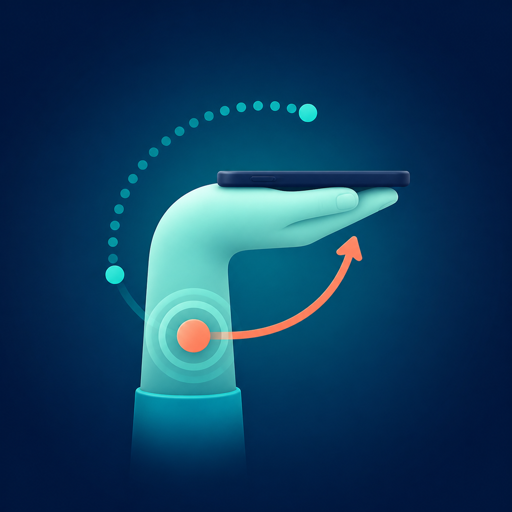
Sense: two inner ears
The accelerometer reads gravity direction and linear acceleration; the gyroscope reads rotation speed. Together they track how the phone's orientation changes.
Under the hood
This guide breaks Wrist Trainer's counting into three stages: sensing, calibration, and decision. Everything runs on the phone itself - and knowing why helps explain when a rep might be missed.
A three-stage pipeline
The accelerometer reads gravity direction and linear acceleration; the gyroscope reads rotation speed. Together they track how the phone's orientation changes.
Held sideways with the screen down for three seconds, the app records gravity at that instant as neutral. Every angle afterwards is an estimate relative to it.
After the relative angle passes the target and holds for the set time, the rep stays pending until the phone returns to the neutral zone. Jitter around the threshold never stacks extra reps.
Design trade-off
The neutral-return rule trades a little combo speed for the guarantee that every count matches one full back-and-forth movement. Per-second haptics show hold progress, a triple pulse confirms completion, and spoken cues announce each count.